Updated: July 2026
The Best Time of Year for a Wakatobi Liveaboard Diving Trip
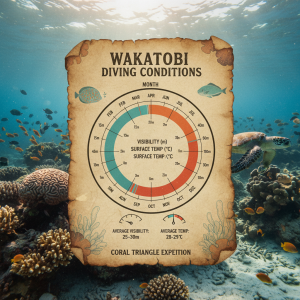
- Prime Visibility: September through November consistently offers the clearest water, often exceeding 40 meters.
- Calmest Seas: March through May presents the flattest surface conditions as the monsoons change.
- Year-Round Excellence: Water temperatures are a stable 26-30°C (79-86°F) all year, making any month suitable for diving.
The gentle hum of the generator is a distant lullaby. On the top deck of the Pelagian, the Celebes Sea is an expanse of polished sapphire under a sky just beginning to blush with the dawn. The air is warm, thick with the scent of salt and the promise of another day in a world apart. Below us lies a kingdom of coral, a place where the density of life can recalibrate one’s entire perspective on nature. As a travel editor, I’ve been fortunate to see many of the world’s premier underwater destinations, but the question I receive most often about this specific corner of Indonesia is not if, but when. Timing is everything, and in a place as dynamic as Wakatobi, the calendar dictates more than just the weather; it orchestrates the entire underwater ballet.
Decoding Wakatobi’s Two-Season Climate
To understand the best time for a Wakatobi liveaboard, one must first dismiss the traditional four-season mindset. Here, just a few degrees south of the equator, the rhythm of life is governed by two prevailing monsoons: the dry season and the wet season. The dry season, influenced by southeasterly winds, typically runs from April through November. This period is characterized by sun-drenched days and minimal rainfall. The wet season, brought on by northwesterly winds, arrives in December and lasts through March. However, the term “wet season” can be misleading. It doesn’t mean perpetual grey skies and downpours. More accurately, it consists of short, intense tropical showers, often in the late afternoon, that refresh the landscape and give way to clear, star-filled nights. Air temperatures remain remarkably consistent, hovering around a pleasant 30°C (86°F) year-round. It’s this climatic stability that makes Wakatobi National Park, a protected area spanning an immense 1.39 million hectares, a viable diving destination 365 days a year. The critical factor for divers is not the rain, but the wind, which influences surface conditions. Our itineraries are designed around this, ensuring that no matter the month, we can access sheltered sites where the underwater world remains serene and undisturbed.
The Shoulder Seasons: A Diver’s Sweet Spot (March-May & September-November)
While any time in Wakatobi is extraordinary, the transitional periods between the monsoons represent the absolute pinnacle for diving. These “shoulder seasons”—March through May and September through November—are when the winds subside, leaving the sea’s surface with a glassy, undisturbed calm. This is the time that our lead dive guide, a man named Haryadi who has logged over 6,000 dives in these waters, refers to as “the great stillness.” During the March to May window, as the wet season recedes, the visibility begins to improve dramatically, often reaching a crystalline 30-40 meters. The water is warm, and the marine life seems to pulse with renewed energy. It’s a fantastic period for macro photographers, as many smaller critters become more active. The later shoulder season, from September to November, is arguably the grand prize. The southeasterly winds have dissipated, and the clarity of the water is at its absolute peak, frequently exceeding 40 meters. On wall dives like the famed Roma or Blade, this clarity creates a profound sense of flying through an infinite blue space, with the entire vibrant ecosystem laid out before you. This is when large schools of chevron barracuda and blackfin trevally are most commonly sighted. Our Wakatobi live aboard itineraries are specifically designed to capitalize on these prime conditions, offering access to the archipelago’s most celebrated sites when they are at their most magnificent.
Diving in the Peak Dry Season (June-August)
The core of the dry season, from June through August, is a popular time for visitors to Indonesia in general, and for good reason. Topside, the weather is nearly flawless, with endless sunshine and very low humidity. This makes for idyllic days spent relaxing on the sundeck of the Pelagian between dives, soaking in the panoramic views of uninhabited islands. Underwater, the story is slightly more nuanced. The same southeasterly winds that guarantee clear skies can also create choppier surface conditions. While this rarely impacts the diving itself—our captains are masters of finding sheltered coves and lee sides of islands—it can make the crossings between atolls a bit more active. Interestingly, these winds can also trigger plankton blooms. While this may slightly reduce the gin-clear visibility of the shoulder seasons, dropping it to a still-excellent 20-30 meters, it acts as a dinner bell for the entire food chain. The reefs become even more animated, and filter feeders like manta rays are more frequently drawn to the nutrient-rich waters. This period is a perfect illustration of Wakatobi’s complexity; a slight trade-off in visibility often yields an even greater reward in marine biomass. After all, this region is a vital part of the Coral Triangle, an area harboring an astonishing 76% of the world’s known coral species, and the ecosystem is always in a state of productive flux.
The “Green Season” Advantage (December-February)
The months of December, January, and February are often overlooked by divers planning a trip, which is precisely why they hold a special appeal for the discerning traveler. We call it the “green season,” a nod to the lush, vibrant state of the islands, refreshed by the afternoon rains. The primary advantage of this period is a profound sense of exclusivity. With fewer vessels in the region, you often feel as if you have the entire national park to yourself. The diving experience becomes more intimate and personal. The northwesterly winds are generally less potent than their southeasterly counterparts, and the rain, as mentioned, is a predictable afternoon event rather than an all-day affair. Underwater, visibility might be at its lowest for the year, but “low” in Wakatobi is still a respectable 15-25 meters. This proximity can be an advantage for macro enthusiasts. The reduced light and water movement can concentrate smaller, rare critters like the pygmy seahorse and ghost pipefish, making them easier for our eagle-eyed guides to spot. Exploring these less-traveled months on a luxury dive safari offers a unique perspective of the archipelago, one that feels wilder and more untouched. It’s the resilience and richness of this UNESCO Biosphere Reserve, which was officially designated in 2012 to protect its unique socio-ecological landscape.
What You’ll See: A Seasonal Marine Life Calendar
The sheer biodiversity in Wakatobi is staggering, and while most species are present year-round, their behavior and visibility can shift with the seasons. The region is home to over 942 documented fish species and 750 coral reef species, a concentration of life that is, according to Indonesia’s official tourism board, among the highest in the world. Certain encounters, however, are more likely at specific times. Throughout the year, Wakatobi’s 50-plus dive sites are a macro photographer’s dream, with countless species of nudibranchs, frogfish, and crustaceans always on display. But if you’re hoping for specific encounters, the calendar can be your guide. The peak visibility of September to November is ideal for appreciating the grand scale of the reefs and for spotting schooling pelagics like jacks and barracuda against the deep blue. The “green season” from December to March often coincides with the mating season for many invertebrates; cuttlefish displays are common, and the diversity of colorful flatworms is at its peak. Later, in the months following the full moons of April and May, lucky divers might witness one of nature’s most spectacular events: mass coral spawning. This synchronized release turns the water into a living snow globe, a fleeting and unforgettable phenomenon that underscores the vitality of these world-class reefs.
Quick FAQ: Planning Your Wakatobi Voyage
What is the water temperature in Wakatobi?
The water temperature is remarkably consistent, ranging from a low of 26°C (79°F) in August to a high of 30°C (86°F) in the warmest months of October and November. A 3mm full wetsuit is sufficient for most divers, though some may prefer a 5mm suit for maximum comfort over multiple dives a day.
Does the “best time” depend on my diving experience?
Not significantly. The sheer diversity of dive sites means our expert guides can always tailor the experience to suit all levels. However, if you are particularly sensitive to surface chop or prefer the calmest possible conditions for relaxing on the boat between dives, the shoulder seasons (March-May and September-November) are your most reliable choice.
Are there specific times for better pricing on a wakatobi live aboard?
Wakatobi is a premium, year-round destination, and our pricing reflects the high level of service and exclusivity we provide. While standard rates are generally consistent, you may find more flexibility or special charter opportunities during the green season (December-February). It’s always best to check our current schedules and availability for the most up-to-date information.
How does the moon cycle affect diving in Wakatobi?
The lunar cycle has a noticeable impact, primarily on tides and currents. The weeks surrounding the new and full moons typically bring stronger currents. While this requires more experienced dive planning, it also acts as a magnet for pelagic species, drawing sharks, rays, and large schools of fish closer to the reef points to feed. It can make for some truly exhilarating dives.
Ultimately, the “best time for Wakatobi liveaboard” diving is a personal calculation, a balance between your tolerance for a bit of surface wind versus your desire for absolute solitude, or your preference for macro life versus wide-angle vistas. The truth is, there is no bad time to visit. The underwater ecosystem is so rich, so vibrant, and so overwhelmingly beautiful that it delivers world-class experiences every single day of the year. The seasonal nuances simply add different flavors to an already exceptional feast for the senses. Ready to witness the biodiversity of the Coral Triangle firsthand? Your cabin aboard the ultimate wakatobi live aboard awaits. Explore our itineraries and let us craft your perfect underwater journey, any time of year.