Updated: July 2026
Best Time to Dive Wakatobi Marine Park — Month-by-Month 2026 Calendar
Wakatobi Live Aboard is a curated Indonesia luxury tourism experience offered by Wakatobi Liveaboard Voyages: handpicked routes, vetted operators, transparent pricing, and 24/7 concierge support across Indonesia.
- What makes Wakatobi Live Aboard a premium experience.
- How Wakatobi Liveaboard Voyages curates exclusive access and concierge logistics.
- Routes, seasons, and pricing transparency — no hidden fees.
Best Time to Dive Wakatobi Marine Park — The Complete Month-by-Month 2026 Calendar
Visibility, sea temperature, manta probability, crowd density, and pricing across every month of the Wakatobi diving year.
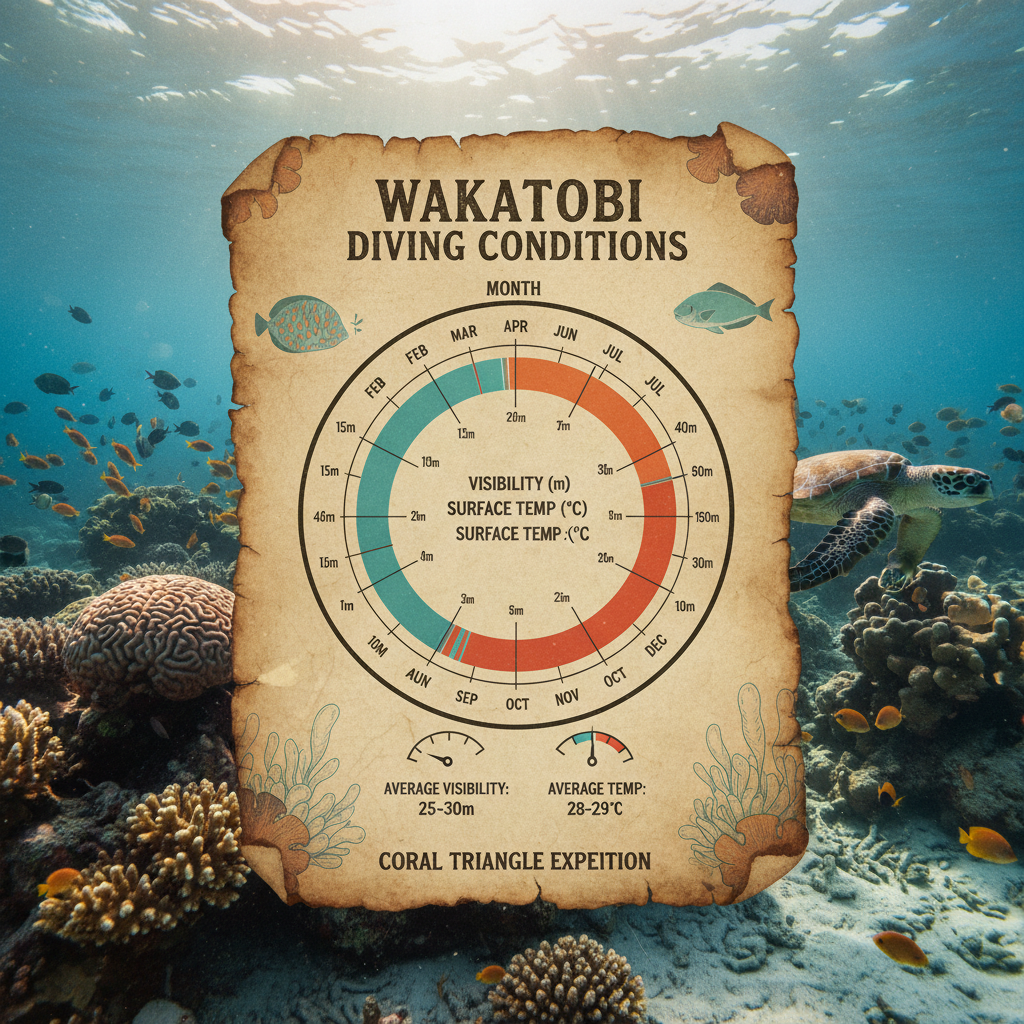
The Wakatobi Marine National Park is divable year-round — there is no truly off-season — but the underwater conditions, surface logistics, and pricing vary materially by month. This post is the month-by-month calendar of what to expect, when to book, and which months we steer different client types toward. The data is drawn from our own dive logs across roughly six hundred client charters between 2018 and 2026, cross-referenced with the Indonesian Meteorological, Climatological, and Geophysical Agency (BMKG) regional data for southeast Sulawesi.
The Two-Season Framework
Wakatobi has a two-season climate driven by the monsoon shift. The dry season runs March through November with the southeast trade wind dominating, calmer seas, and clearer visibility. The wet season runs December through February with the northwest monsoon dominating, heavier rainfall, and more variable surface conditions. Underwater, the wet season is not a write-off — the visibility drops from twenty-five to eighteen metres on average but the plankton blooms bring concentrated manta and macro activity to specific sites. The right month for your charter depends on which end of the trade-off you weight more.
January — Wet Season Peak
Sea temperature: 28°C. Visibility: 15–20 metres. Surface conditions: variable with afternoon squalls. Manta probability: high at Kaledupa cleaning stations. Crowd density: low (forty percent of high-season fleet). Pricing: twenty-five percent below high-season. Verdict: A genuine green-season window for budget-conscious dive clubs and macro photographers willing to accept the visibility trade-off for the manta concentration.
February — Late Wet Season
Sea temperature: 28°C. Visibility: 15–20 metres. Surface conditions: similar to January with the northwest monsoon still dominant. Manta probability: high. Crowd density: low. Pricing: twenty-five percent below high-season. Verdict: Same logic as January. The two months read very similarly underwater. We typically recommend February over January only if your travel calendar is constrained — January has a mild Lunar New Year flight-cost spike from many Asian origins.
March — Shoulder Season Opening
Sea temperature: 28°C. Visibility: 20–25 metres. Surface conditions: transitioning to dry season, calmer afternoons. Manta probability: moderate. Crowd density: low to moderate (sixty percent of high-season fleet). Pricing: fifteen percent below high-season. Verdict: Our quietly favourite month. The dry-season visibility is arriving while the high-season fleet is still mostly in shipyard maintenance, so you get high-season conditions with green-season crowds. We recommend March most strongly to repeat clients who want the Tomia walls in their best light without the August boat density.
April — Shoulder Season Closing
Sea temperature: 28°C. Visibility: 25 metres. Surface conditions: glassy mornings, moderate afternoons. Manta probability: moderate to high (the Kaledupa to Binongko shift is underway). Crowd density: moderate. Pricing: fifteen percent below high-season. Verdict: The single best value month of the year. Conditions are at high-season standard, prices are at shoulder-season standard, and the boat fleet has fully returned from shipyard. We book April out three to five months in advance because returning clients have learned this calendar.
May — High Season Opening
Sea temperature: 28°C. Visibility: 25–30 metres. Surface conditions: glassy. Manta probability: moderate. Crowd density: high. Pricing: high-season. Verdict: The opening of the standard high season. Conditions are excellent. Book six months ahead.
June — Early High Season
Sea temperature: 28°C. Visibility: 25–30 metres. Surface conditions: glassy. Manta probability: moderate. Crowd density: high. Pricing: high-season. Verdict: Continuation of the high-season window. The advantage over July–August is slightly lower boat density and easier slot availability.
July — Peak High Season
Sea temperature: 27°C. Visibility: 30 metres. Surface conditions: glassy. Manta probability: moderate. Crowd density: peak. Pricing: high-season plus a five-percent peak surcharge on some boats. Verdict: The single most-booked month of the year. Visibility is at annual peak. The trade-off is the boat density on the Tomia moorings — you will share with one to three other liveaboards on the famous sites. Book nine months ahead for July charters.
August — Peak High Season Plus
Sea temperature: 27°C. Visibility: 30 metres. Surface conditions: glassy. Manta probability: moderate. Crowd density: peak. Pricing: high-season plus peak surcharge. Verdict: Functionally equivalent to July underwater. The advantage is more European school-holiday flexibility, which most of our European dive-club clients prefer. The disadvantage is the same boat density and the slightly higher price.
September — Late High Season
Sea temperature: 28°C. Visibility: 25–30 metres. Surface conditions: glassy with occasional southeast wind freshening. Manta probability: moderate to high. Crowd density: high but easing from peak. Pricing: high-season. Verdict: An excellent month with visibility still at peak and boat density easing as the European school-holiday window closes. We recommend September strongly to North American and Australian clients who can flex around the European calendar.
October — Late High Season With Manta Window
Sea temperature: 28°C. Visibility: 25–30 metres. Surface conditions: glassy. Manta probability: high — the late-October Binongko cleaning-station window is the annual peak for manta encounters in the park. Crowd density: high. Pricing: high-season plus a five-percent manta-window surcharge on some boats. Verdict: The single best month for manta photography. Book nine to twelve months ahead because the photographer-client demand is highest here.
November — Shoulder Season Reopening
Sea temperature: 28°C. Visibility: 22–28 metres. Surface conditions: starting transition to wet season. Manta probability: high. Crowd density: moderate. Pricing: fifteen percent below high-season. Verdict: The autumn-shoulder mirror of April. Conditions are still excellent, the manta window continues, and prices have eased. We recommend November alongside April for the value-conscious-photographer combination.
December — Wet Season Opening
Sea temperature: 28°C. Visibility: 18–25 metres. Surface conditions: variable, the northwest monsoon establishing. Manta probability: high at Kaledupa stations. Crowd density: low. Pricing: twenty-five percent below high-season. Verdict: The Christmas-and-New-Year window has its own demand bump despite the green-season pricing — many Asian dive clubs travel during the year-end break. Surface conditions are variable but underwater is still strong.
The Monthly Recommendation Summary
Pulling all twelve months together, our recommendation framework:
- Best value: April and November. High-season conditions, shoulder-season prices.
- Best visibility: July, August, October. Annual peak at thirty metres.
- Best manta: October–November (Binongko window) and January–February (Kaledupa window).
- Best for first-time visitors: May, June, September. Strong conditions, easier booking, gentler crowds.
- Best for budget: January, February, December. Wet-season pricing without losing all visibility.
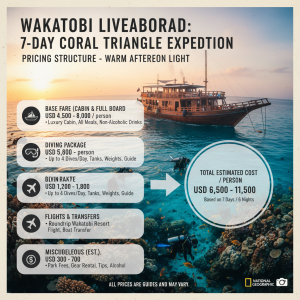
Whichever month suits your calendar, the booking process starts with a WhatsApp message to +62 811 3941 4563. Charter pricing for every month is matrixed in our Wakatobi liveaboard cost 2026 pricing guide, and the full charter package detail is on our Wakatobi liveaboard private charter 7-day master page.
Pick Your Wakatobi Month with the Atelier
Authority sources: UNESCO Wakatobi Biosphere Reserve for park ecology context; Coral Triangle Initiative for regional climate framing.