Updated: July 2026
Wakatobi Live Aboard — Wakatobi vs Raja Ampat — The Honest 5-A…
Wakatobi Live Aboard is a curated Indonesia luxury tourism experience offered by Wakatobi Liveaboard Voyages: handpicked routes, vetted operators, transparent pricing, and 24/7 concierge support across Indonesia.
- What makes Wakatobi Live Aboard a premium experience.
- How Wakatobi Liveaboard Voyages curates exclusive access and concierge logistics.
- Routes, seasons, and pricing transparency — no hidden fees.
Wakatobi vs Raja Ampat — The Honest Five-Axis Comparison Most Liveaboard Operators Avoid
Eight years curating both destinations, six hundred client charters reviewed, and the unfiltered breakdown of price, accessibility, biodiversity, crowding, and gear logistics.
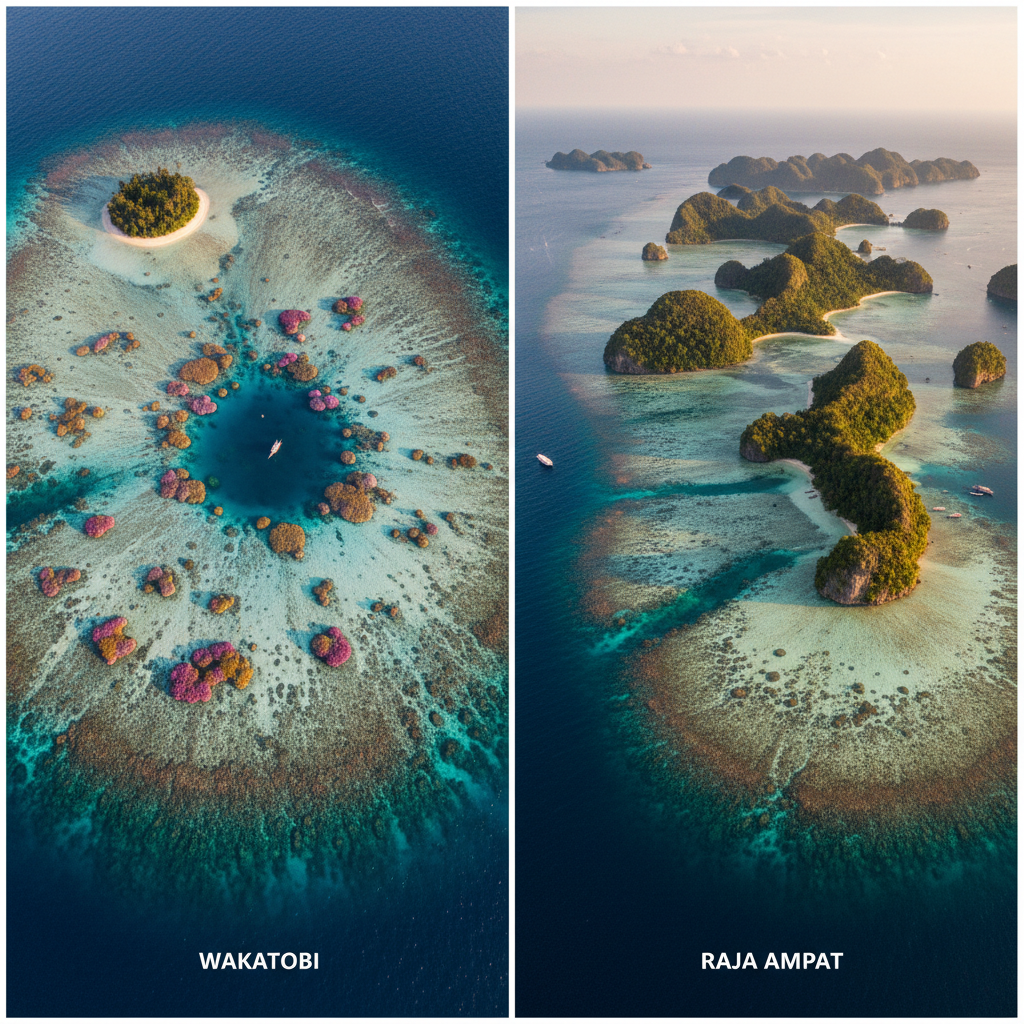
Wakatobi versus Raja Ampat is the single most asked question we field at the atelier, and it is the question most liveaboard operators sidestep because they only sell one of the two. We curate both — Wakatobi as our flagship and Raja Ampat through our partner desk — and we have a clean dataset of roughly six hundred client charters across both destinations between 2018 and 2026. This post is the unfiltered version of the comparison: where Wakatobi genuinely wins, where Raja Ampat genuinely wins, and which destination matches which type of dive group. If you want our flagship product after reading, jump to the Wakatobi liveaboard private charter 7-day master page.
The Five-Axis Decision Framework
Both destinations sit inside the Coral Triangle, both hold World-Heritage-tier biodiversity, both run liveaboard-only properly, and both are reachable from Bali within a single travel day. The differences live on five axes — price, accessibility, biodiversity composition, crowding, and gear logistics — and the right destination for your group depends on which axis matters most to you. We rank each destination on each axis below with the supporting evidence.
Axis One — Price
Wakatobi wins on price by roughly thirty percent. A standard seven-day Wakatobi liveaboard on a comparable boat tier runs US$2,890 per diver in our 2026 pricing. The equivalent seven-day Raja Ampat charter on the same boat tier runs US$3,890 to US$4,290. The cost driver is fuel, harbour clearance, and crew rotation: Raja Ampat charters typically operate from Sorong harbour with longer ocean passages and higher operational fuel burn, while Wakatobi operates a shorter perimeter from Wanci. The gap holds across all four boat tiers — Standard, Premium, Luxury, and Signature — with Raja Ampat consistently twenty-five to thirty-five percent more expensive at the same tier. Verdict: Wakatobi wins decisively.
Axis Two — Accessibility from Bali
Wakatobi wins on accessibility from Bali, by a meaningful margin. The Wakatobi flight chain is Bali → Makassar → Kendari → Wanci, four hours of total flight time across three carriers, completable in a single travel day. The Raja Ampat flight chain is Bali → Makassar → Sorong, six hours of total flight time across two carriers, with most divers preferring an overnight in Sorong before embarkation to absorb potential delays. From the United States, Europe, or Australia, the Wakatobi chain is one travel day from Bali; the Raja Ampat chain is one and a half travel days from Bali including the Sorong overnight. Verdict: Wakatobi wins by half a day of total transit.
Axis Three — Biodiversity Composition
This is the closest axis and the answer depends on what you want to see. Wakatobi has 942 reef-fish species and 750 hard-and-soft coral species recorded inside the marine park, with the Tomia walls showing seventy to eighty percent live hard coral cover at twenty-five metres — a coverage figure that matches anywhere on the planet. Raja Ampat has 1,427 reef-fish species recorded across the four-island archipelago and 553 hard coral species, with the Dampier Strait and Misool sites showing comparable hard coral cover. Wakatobi wins on coral coverage and coral diversity at depth. Raja Ampat wins on fish diversity and on pelagic concentration — the Dampier Strait currents pull mantas and grey reef sharks reliably to known cleaning stations, while Wakatobi’s manta activity is more seasonal and concentrated to the Kaledupa and Binongko stations. Verdict: Roughly tied with different strengths. Coral photographers favour Wakatobi; pelagic and fish photographers favour Raja Ampat.
Axis Four — Crowding and Site Density
Wakatobi wins decisively on crowding. The Wakatobi Marine National Park sees roughly fifteen liveaboards operating in any given peak month, spread across an area of 1.39 million hectares. We typically share a Tomia mooring with one other liveaboard, occasionally none, never four. Raja Ampat sees roughly forty-five liveaboards operating in peak month across a comparable park area, and the famous sites — Cape Kri, Manta Sandy, Boo Windows, Magic Mountain — see four to seven boats sharing a mooring during the November–February peak. The crowding gap matters most for photography clients who want clear water-column shots and for nervous divers who prefer smaller buddy groups in the water. Verdict: Wakatobi wins by a factor of three on diver density.
Axis Five — Gear Logistics and Currents
Raja Ampat wins on gear logistics, surprisingly. The Sorong harbour has full dive-shop infrastructure with PADI five-star dive centres, Nitrox banks, rebreather support, and emergency dive-medicine logistics including the Sorong recompression chamber. Wanci has functional dive-shop infrastructure but no recompression chamber on the island; the nearest chamber is Makassar, six hours by air ambulance. Both destinations require divers to pay attention to currents, but Raja Ampat currents are more variable and more challenging — drift dives at the Dampier Strait can run three knots, and the famous Cape Kri current is genuinely demanding. Wakatobi currents are gentler in aggregate, with most Tomia walls running at half-knot to one-knot drift, suitable for Open Water divers with modest current experience. Verdict: Raja Ampat wins on logistics; Wakatobi wins on accessibility for less experienced divers.
The Aggregate Verdict — Which Destination for Which Group
Pulling the five axes together, our recommendation framework is unambiguous:
- Couples on first Coral Triangle trip: Wakatobi. Lower price, easier travel, gentler currents, better honeymoon ambience on the smaller boats.
- Photography clients with macro priority: Wakatobi for the Hoga macro density and the Tomia wall colour at depth.
- Photography clients with wide-angle pelagic priority: Raja Ampat for the Dampier mantas and the Misool pelagics.
- Dive clubs of ten to twenty: Wakatobi for the cost economics on full-boat charter.
- Technical and rebreather divers: Raja Ampat for the Sorong recompression chamber and the deeper Misool walls.
- Repeat Coral Triangle veterans: Whichever they have not already dived. Roughly forty percent of our repeat clients dive both in alternating years.
The Cost Comparison Table
Seven-day liveaboard charter, per diver, all-in, 2026 pricing on equivalent boat tiers:
- Standard tier — Wakatobi US$2,890 / Raja Ampat US$3,890
- Premium tier — Wakatobi US$3,690 / Raja Ampat US$4,690
- Luxury tier — Wakatobi US$4,290 / Raja Ampat US$5,690
- Signature tier — Wakatobi US$5,890 / Raja Ampat US$7,890
Add roughly US$400 to the Raja Ampat figures for the Sorong overnight that most divers add to the chain. The full Wakatobi pricing matrix is on our Wakatobi liveaboard cost 2026 pricing guide.
The Travel-Day Comparison
From Bali, Wakatobi is one travel day with the Bali → Makassar → Kendari → Wanci chain. Raja Ampat is one and a half travel days with the Bali → Makassar → Sorong chain plus the recommended overnight in Sorong before embarkation. The complete Wakatobi travel route is documented in our Wakatobi from Bali travel route guide.
The Marine-Park Permit Comparison
Both destinations require marine-park entry permits, and the cost and process differ. Wakatobi Marine National Park entry permit runs Rp 150,000 (roughly US$10) per diver per visit, paid through the liveaboard operator at embarkation, and is valid for the entire charter. Raja Ampat Marine Park entry tag runs Rp 1,000,000 (roughly US$65) per diver per visit, valid for one calendar year, and must be physically collected from the Sorong harbour office or the Waisai harbour office before boarding. The Raja Ampat tag is genuinely a year-long permit that can be reused on subsequent trips inside the calendar year. The Wakatobi permit is single-charter only.
The Final Honest Take
If we had to send a first-time Coral Triangle diver to one destination, the answer is Wakatobi. The price is more accessible, the travel is easier, the currents are gentler, the crowds are smaller, and the coral coverage at depth matches anywhere on the planet. If we had to send an experienced Coral Triangle veteran chasing pelagic photography, the answer is Raja Ampat. The two destinations complement each other rather than substitute for each other, and our most successful repeat clients dive both — Wakatobi first to learn the Coral Triangle pace, Raja Ampat second to chase the pelagics. Either way, the WhatsApp consultation at +62 811 3941 4563 is the start of the conversation, and the seven-day flagship is documented in detail on our 7-day charter master page.
Talk Wakatobi vs Raja Ampat with the Atelier
Sources: UNESCO Wakatobi Biosphere Reserve for park biodiversity figures; Coral Triangle Initiative for regional context.